Showing posts with label friends. Show all posts

June 23, 2015

Remembering two friends: Warner and L.C.

     Asphalt and I are well-acquainted.  As I motor over about 1,000 miles of blacktop per week, I often think about friends who now live in memories.   
     Monday, I glanced at my fingers wrapped around the steering wheel.  Noticing paint smudges, my mind raced back to the 1980s.  I was walking in the back door of the kitchen of Northside Elementary School.  Warner Yeomans was elbow-deep in suds, washing a pot half the size of a VW Bug.
      “Hey, Warner, I didn’t expect to see you here,” I said.  The retired fireman said, “Well, I needed a job to get health insurance.”  I asked whether he liked washing dishes, and he said, “Not really, but I need the insurance.”  Before long, he joined us at the newspaper.  He liked “running the routes,” delivering newspapers to post offices and stores.  And he really loved our little blue Nissan truck, but that’s another story.

     Besides being an ace firefighter, Warner was a wizard with a paint brush.  There’s no way to count the houses and rooms he painted.  Warner’s schedule at the fire department gave him ample free time to handle his customers.  We were lucky to have him as our go-to paint guy, too.   I don’t pry open a can of paint without thinking about Warner.  What a pleasant, easygoing and loyal friend he was.  And I don’t look at my lightweight aluminum boat that I don’t see Warner—with paint smudges on his hands—smiling and holding a fishing pole.   
     That mental image—Warner pulling in a white perch, while sitting in that pea-green skiff—made my mind drift toward memories of another friend—L.C. Cogdell.  L.C., like Warner, was a joy to be around.  He was always upbeat, and I enjoyed prodding him to tell another of his stories. 
     L.C. and I got to know each other putting on fish fries.  And that’s what we were probably doing, frying some of Warner’s white perch, when L.C. recounted his days at Henry Ford’s Richmond Hill plantation. After Ford purchased the Georgia property, he recruited L.C., a school principal, to supervise his house staff.

May 12, 2015

Even on the farm, ‘Dying is a part of living’

     Standing under the canopy of an antique water oak, I could hear the squeals and laughter.  The
thermometer’s mercury was flirting with 90, and the lake was beckoning fun-seekers to play in the still- going-to-give-you-goose-bumps water.  Looking up, I spied a kid bouncing on an inner tube, and I heard the throaty roar of the inboard engine, as the boat’s throttle was shoved forward.
     I made a mental note: “It’s time to spring-clean our boat.”  But at that moment, I was preoccupied in the shade, staring at two mounds of red clay that were circled by a lush carpet of fescue.  Beneath those humps were two recently deceased farm favorites—Rose and LG.  My friend Dr. Lanier Harrell reminds me, “Dying is a part of living.”  Yes, even on the farm.
     There was a time when neighbor Pete Craft said, “You have about 100 animals with names, expecting to be fed—every day.”  A rattling feed bucket brings them running. There’s a bountiful spread of grass, but I enjoy feeding the critters as much as they like to eat.  Some are more enthusiastic than others.  That’s why I was leaning against the big oak, reminiscing about the loss of a big mule and an old goat.
     Rose was the first to die.  That love-to-have-her-rump-scratched draft mule was often the first to meet me at the wooden gate.  When I bought Rose and her teammate, Ruby, from Randy Leggett, he said, “She’ll put her head on your shoulder when you groom her mane.”  Randy was right.  Rose was a sweetheart.  I believe she would have plopped all 1,200 pounds into my lap, if I had invited her to sit.
     By the time Rose turned 27, her hips and knees were spent.  She’d get down and couldn’t get back up.  Time after time, I called the veterinarian.  I would kneel by Rose and whisper into her ear, “Come on, girl, we’ve got to get you up.”  Dr. Alice Beretta and friends would help in the struggle.  Finally, the day came.  The petite vet advised, “It’s time.”  
     I couldn’t watch.  I chose to focus on Rose’s velvety, volley-ball-sized lips plucking an apple from my palm.  I remembered the dozens of wary visitors who had to be convinced Rose was after an outstretched apple and not his or her fingers.

August 5, 2014

It’s hard to stop digging in nostalgic cobwebs

    
In the 1950s, Jesup was home of three state football championships.  The Jesup High Yellow Jackets, coached by John Donaldson, won the crowns in 1954 and 1959.  The Wayne County Training School Tigers also were champs in 1959.  According to the WCTS yearbook, The Jesupsonian, and The Jesup Sentinel, members of that title-winning Tigers team were, front row, from left, Walter Myles, Don Jackson, Charles Hines, Willie Holmes, Otis Sapp, Willie Earl Johnson, Ulysess Moses and B. Stephens; back row, from left, Leavon Collins, Edward Lee Brown, Simon Holmes, F. Moses, Nathaniel Greene, R. Bryant, Willie Lovett, Allen Scott, Paul Trammel and Tommie Reddish.  Not pictured were Herman Latson, Earl Carter, Alfred Kincy, John L. Flowers, Charles Walker, Pete Adams, Dave Walker, Johnnie Carter, Tommie Gaines, Leon Carter, Felton Dickens, Jerry Jones and Joseph Wilcox.  The coaches were Arthur Williams, T.J. Toney and Curtis Moreland.
     Nostalgia is for some—like me—akin to eating hot, boiled peanuts.  Once you start digging into the damp paper sack or into cobwebs of your mind, it’s hard to know when to stop.  Last week, I had to push back from my computer, after making a list of about 75 flashbacks.  
     And when the paper hit the streets, the e-mails started popping.  Carol Reddish Keith was the first to respond.  Classmate of 1966 Larry Brannen was second.  LB agrees with me.  He misses the fiddling neon porker on the sign of The Pig.  But most of all, we miss the world’s best barbecue, inside Sine and Vada Aspinwall’s restaurant.
     Carole dialed up memories of her grandmother living in the old Walnut Street jail and cooking for the inmates.  It was a two-cell brick lockup, with Mrs. Sidney Reddish serving some of the best eats in Jesup. Those e-mails and others spurred more digging in my cobwebs.  Here’s what I found:

June 3, 2014

J.W. loved to tell this story about his friend C.J.

Driving down Highway 15, just north of Siloam, I always slow 
down to see what pithy saying the Rev. Roi Johnson has for his 
congregation at New Springfield Baptist Church, as well 
as for passersby.  This marquee message stirred my memory 
of one great Georgian, Dr. J.W. Fanning, telling a story about 
his friend—another great Georgian, Cason J. Callaway.
     C.J. and J.W. were born 11 years and 150 miles apart, but both grew up learning “which end of the mule kicks.”  C.J. was a prosperous merchant’s son in Troup County.  J.W. was a cotton farmer’s son in Wilkes County.  And by the time they’d meet, their wallets would be tens of millions of dollars apart.  Still, their shared passion—agriculture—brought them together to cultivate C.J.’s progressive idea.
     “Cason J. Callaway was the only 50 million dollar man I ever met,” Dr. J.W. Fanning once told me.
  “And he surely knew how to put his money to work, making the world a better place.”   The cotton mill magnate and future founder of Callaway Gardens invited Fanning, a county extension agent, to spearhead the 100 Georgia Better Farms.
     The economic drought of the Depression lingered, and Georgia’s farmers were struggling in the 1940s.  Callaway wanted to plow his ideas and dollars into the state’s farms, hoping to make a difference.  He had been an innovator in terracing, fertilization and trying new crops.  
     Callaway’s vision and success were like a magnet, attracting 700 other businesses to contribute $1,000 each to help underwrite the effort.  Fanning taught business-like efficiencies, along with the Callaway way.  Before long, almost all of the participating farms were turning profits.
     When the 100 Farms initiative was done, that wasn’t the end of Callaway and Fanning’s association.  They remained friends and mutual admirers until Callaway’s death in 1961.  Dr. Fanning liked reminiscing about the famous Georgian from Blue Springs in Harris County.  My mentor especially enjoyed retelling the story—as originally told by Callaway—of the famous gardens’ founder and his ambition to corral Mountain Creek.

May 27, 2014

Strike up the band, as the Class of 1966 turns 66

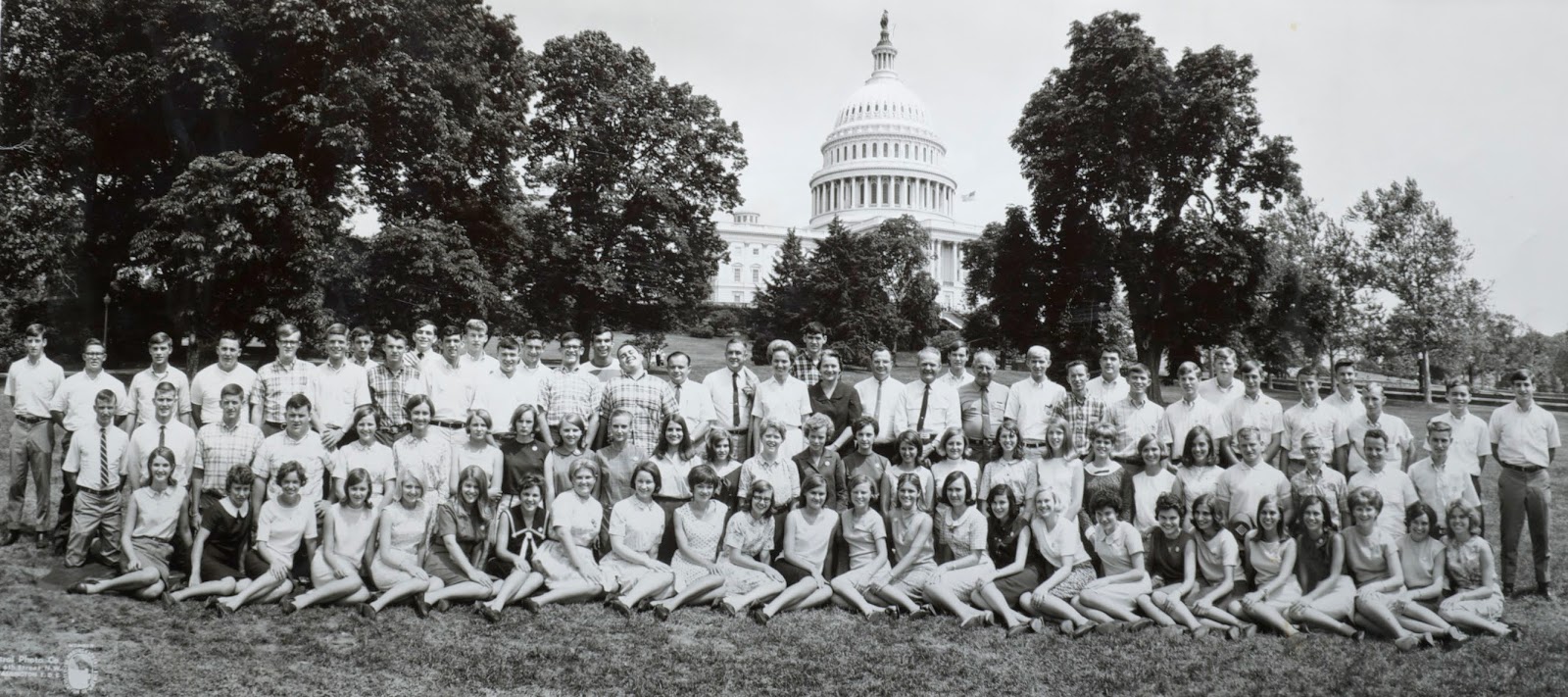
A half-century ago, many people considered high-tech to be electric typewriters and color TV.  And for many in the Class of 1966, a panoramic camera was high-tech, too.  As the Jesup High School graduates posed on the lawn of the U.S. Capitol, class president Jimmy Watson appeared on both ends of the group.  How did he do that?  When the photographer gave the sign, Jimmy ducked and raced behind his classmates to reach the other end before the sweeping lens got there.  Traveling as chaperones were Barry Weinstein, Ashley and Anita Madray, Kathleen Hires and Jim Collins. (Photo courtesy of Joe and Judy Bennett Phelps)  
     When you are 17, you believe you are going to live to be 100.  But on a 1965 summer morning, the Class of 1966 awoke, realizing that belief was a cruel myth.  Cary Bennett’s death in a car crash wasn’t just a bad dream.  It was a nightmare that shook us awake.
     I remember walking into the locker room and staring at the steel cage where Number 45’s jersey “Cary’s gone!”      
Dink NeSmith, circa 1966
was hanging.  Cary was supposed to be there, peeling off his street clothes and putting on his sweaty gridiron gear.  That’s when reality hit: 
     The popular rising-senior’s funeral was the first, but many have followed since Principal Charles E. Bacon and Superintendent James E. Bacon handed us our diplomas on May 31, 1966.
     Fast-forward almost a half-century.  Someone had an idea. Maybe it was Kenny Bryant or his wife, Patti Park Bryant.  Maybe it was Angela Walker Story, Beverly Westberry Leaphart, Tricia Bennett Neace or Ann Bailey Lane.  Many people—but not me—deserve credit.  Still, somebody did the math.  Most of the class members were born in 1948, and we’ve been out of Jesup High for 48 years.  Then consider the Class of  ’66 is turning 66.  So what does that mean? 
     It’s party time!
     After months of planning, the shindig is this weekend.  Angie, whose dad owned Walker Chevy-Olds back in our youth, is reopening the former dealership showroom for the celebration.  We danced on that terrazzo floor about 50 years ago, when she hosted a Christmas party.  
     As Yogi Berra said, “It’s déjà vu all over again.”
     The older I get, the more I poke around in my cobwebs, searching for memories that I don’t want to misplace.  Mark Twain joked, “When I was young, I could remember anything whether it happened or not.”  Thinking about 1966, I am convinced these things really did happen: