Showing posts with label family. Show all posts

September 14, 2015

Aunt Lillie could bark with the best of ’em

     Maybe it was the World War II sergeant stripes that she wore or the fact that none of her
marriages took.  Whatever the reason, Aunt Lillie could bark with the best of them. Her grumpiness was legendary in our family.  But as a little boy—standing in for the child she never had—I found a crack in her fire-breathing persona.
     Beneath that gruffness was a woman who liked to talk, and she wanted someone to listen.  When I was 12, I got to listen for two weeks—all the way from South Georgia to Vermont and back.  She was determined to show me Washington, D.C.; New York; and New England.  And she did, from the front seat of her red and black, un-air-conditioned, 1957 Chevy station wagon.   
     We weren’t 10 miles into South Carolina before she started barking at the predicament we were in—sandwiched in the middle of a too-slow-for-her Army convoy.  Hanging her head out the window, she saw a chance to leave the military trucks in her Chesterfield cigarette’s smoke.  Swerving left, she gunned the V-6.
     Within a half-mile, the big olive-drab trucks rumbled past us.  A state trooper was asking, “Ma’am, what’s the hurry?”  It’s a wonder the officer didn’t triple the $10 fine when she barked, “And how much of that are you putting in your pocket?”  
     My dad’s oldest sister was short on diplomacy, and I guess that’s why everyone was happy that she latched onto me.  For decades, I was the designated listener to Aunt Lillie’s needs. She was fiercely independent, but she knew how to play me like all 88 keys on a piano. And she wasn’t bashful about asking. In her early 80s, Aunt Lillie called to say that she needed a new car.   
     “OK,” I said, “let’s lease one.”  
     “What!” she barked. “You think I’m not going to live long?”
     “Well,” I said, “I was just thinking.”
     “Well,” she said, “I think I want a Honda Civic.”
     I suggested that she take a test drive.  Two days later, she called back on my 800-number. (She really liked that.)  “I changed my mind on that Honda.”
     “Why?”
     “Hondas have bucket seats, and my bucket is way too big to fit in theirs.  Now, I want a Chevy Malibu.”

September 8, 2015

New school year brings back old memories

     Sometimes, my brain gets wonky. About every six months, I rattle awake wondering: “Why didn’t I study for this final exam?  Why did I skip so many classes?  Where’s the classroom anyway?”
     Maybe listening to grandsons talk about the start of their new school year caused me to dream that, again.  And since I was staring at the ceiling, I lay there thinking about my school days.
     Aletha Poppell, Barbara Bielfelt, Mildred Jones, Gussie Richardson, Paige Nichols and Sara James did their best with me in elementary school.  After first grade at T.G. Ritch, we moved across the tracks to 111 West Orange.  For five years, I walked six blocks to Orange Street Elementary.  Principal Tom James taught me that there’s a “pal” in principal.  His wife, Sara, showed me how to grip a Louisville Slugger, as well as get me ready for junior high.

     Jesup Junior High was back across the tracks.  I can still smell the oil-soaked floors and hear the boards creak beneath the stampede of students.  Principal James Bacon, with his booming baritone, starched white shirts and slicked-back black hair, gave no doubts that he was in charge.  
     I learned he was my pal, too.  The popular thing for advanced students was to take French in the eighth grade.  Even though I was in the honor society, I was nowhere near the top of my class. My homeroom teacher didn’t think I should try a foreign language.  She told Mr. Bacon, “The boy barely has a grasp of the English language.”  My pal overruled saying, “I think we should give him a chance.”  An A+ in French couldn’t have given me a bigger boost.
     As long as Nanelle Bacon lived, she teased our children.  “Your daddy almost flunked the seventh grade because he couldn’t do decimals,” she said.  “Then I told him to put a dollar mark in front of them.  He never missed another problem.”  
     Tim Cockfield had a challenge teaching me beginning algebra, too.  I did learn, however, that he was our own wisecracking Johnny Carson.  One day our math teacher was sitting on his desk, swinging his feet.  Someone commented, “Mr. Cockfield, you have on a yellow sock and a green sock.” He fired back, “Yeah, I know.  I’ve got another pair just like them at home.”
     Out on the end of West Orange, the letters on the side of the low-slung brick building read Wayne County High School.  Still, we called it Jesup High School.   From day one, we knew C.E. Bacon was in command.  The principal’s military-like voice—over the intercom—brought the campus to attention.

July 7, 2015

Stella, here’s some advice from Grandpa

Dear Stella: 
     By the end of your first birthday party, I had taken 87 snapshots.  Looking through those digital
images, three things made me smile:
  •    We waited 38 years to celebrate another pink bow in our family.
  •    You are as beautiful as we could ever have imagined.
  •    With a big brother and six boy cousins, you’ll be a well-protected princess.

     Even as smart as you are, it’s a little early for you to be reading Charles Dickens.  But one day, you’ll open the pages of A Tale of Two Cities and read about “the best of times and the worst of times.”  The statement from that 1859 novel also describes the era in which you were born. 
     America and the world are teetering.  Emotions and actions are as unbalanced as I’ve known in my 66 years.  With each sunrise, I wonder: “What crazy thing is going to happen today?”  The persistent challenge is not to lose optimism.  Collectively, we have more intelligence, more ability and more tools than ever to make this a better world.  The question is: “Will we use those advantages in a positive way?”
     You are much too young to get caught up in all that.  Instead, here’s some everyday advice that I hope will be useful in your life’s journey.
  •    Family and friends are the only true wealth you’ll ever accumulate.  Honor those dear to you and guard that beloved circle, just as soldiers protect America’s gold inside Fort Knox.  Never forget that to get respect, you must give respect.  And as Wynonna and Naomi Judd sing: “Love can build a bridge.”
  •    Your great-grandmother NeSmith is in Heaven, but she left behind this message: “God keeps us in a swivet to keep us humble.”  Take pride in yourself, but never think you’re too good to escape the swivets.  Stay calm.  Have faith in God and yourself.  Use your gifts.  You will prevail, just as “the little engine that could.”
  •    Your great-grandfather NeSmith is in Heaven, too.  Still, he’d want you to know that no matter how poor we might be, we can always afford to be a lady or a gentleman.  Good manners, he believed, will get you to places where money never will.  And if he made a promise, that was a debt that must be paid. 
  •    Another great man in my life was Dr.  J.W. Fanning.  His motto was: “May you stay alive as long as you live.”  That’s what he did for 92 years, and that’s my wish for you.  Be curious, ask lots of questions.  Embrace education: read, read, read.  Don’t be afraid to dream or chase those dreams.  Be different, if you choose; just always strive to make a difference.  Have courage to say “no,” with authority.
  •    Make sure you enjoy your childhood, because in old age those happy memories are often better than medicine. And when you get as old as I am, you’ll find that you’ll be repeating yourself more and more.

     So, Stella, I repeat: “With a big brother and six boy cousins, you’ll be a well-protected princess. “ I am not too worried about that, but still you might want to talk to your Aunt Emily.  When the boys start bringing you flowers, she can confirm that I am a skilled Grand Inquisitor.
     Please send those fuzzy-faced rascals to see me.
     Love, 
     Grandpa


January 6, 2015

Marjorie Vines NeSmith


“Life should be measured not by the number of years, but rather by the love shared, the memories made, the joy given and the blessings received.” –Unknown

     As I stand here, thinking about Marjorie Vines NeSmith, there’s no way to measure the love shared, the memories made and the joy given by my mother in her 90 wonderful years on this earth.  And there’s no way to measure the blessings we’ve received during her 32,950 days, 790,819 hours or 47,316,080 minutes she breathed hope, love and encouragement into her family and friends.
     On behalf of her three children, sisters Sandy, Sheila and me, along with her six grandchildren (Blaine, Alan, Morgan, Emily, Sail and Eric) and nine great-grandchildren (Will, Wyatt, Hayes, William, Henry, Fenn, Bayard, Smith and Stella) I say thank you to this church and this community.  You have been our rock of support, our true north on our family’s compass.  And when Sandy, Sheila and I knew Mother’s days were short, our compass and hearts pointed right to here—home.  When the time came for Mother to go to heaven, we wanted the ascent to be from a happy place, the place she loved most, Jesup and Wayne County.
     During the Thanksgiving week, I made a few phone calls and visits.  Just as I knew you would, you flung open your arms and your hearts to welcome Mother back home.  With your help, we were able to give Mother our best ever Christmas present.  She was able to exchange goodbyes with so many of you.  Time and time again, over the last 30 days, we were reminded that God answers prayers and opens doors. 
     In these Charles Dickens-like “best and worst” of times, we’ve sung your praises.  Hospice of South Georgia was heaven-sent.  And two of the most magnificent angels we will ever meet were her caregivers, Shelli and Joey Williams.  How blessed Mother and our family have been to be under your umbrella of love and compassion.  We are forever indebted and grateful.
     Sixteen years ago, I stood before you to celebrate my father’s 76 years and thank you for your loving devotion to the NeSmith family.   And just like then, I now give the same answer, when you asked: “What can we do?”  I say, again, don’t let the memories or stories of Margie NeSmith die.  Please keep those memories alive.  One day, share your favorite recollection with her grandchildren, great-grandchildren or yet to be born great-great grandchildren.  That’s the best gift you could give us.
     There are so many stories that I could tell.  Here’s perhaps my favorite, because it tells the origin of our family—one that puts me here, standing before you today.
Let’s go back to 1930.  Side-by-side the two families lived in the small village of Putney, outside Albany in Southwest Georgia.  Between the two houses, there were nine children and one radio.  No one complained about the lack of television, video games, computers or the Internet.  None of the nine imagined those entertainment gadgets any more than a man walking on the moon.  That’s why the blended band of the Great Depression Era children was in the yard and up a tree, playing.
         The limbs were shaking with laughter until the youngest girl dropped her doll.  When its porcelain face shattered on the hard Doughtery County dirt, the curly-headed 6-year-old started to cry.
     Scrambling down, the kids were pelted with falling tears.  All vanished except one.  An 8-year-old boy helped his grieving playmate to the ground.  Patting her shoulder, he said, “Please don’t cry.  One day, I will get you a baby doll even prettier than this one.”
     Before long, the train whistle blew, calling the boy’s father to another railroad job on the other side of the state.  Seven years passed.  The little girl’s father decided to take a trip to see his old neighbors.  With his wife and children packed into their Packard, they were surprised to see an older but familiar face greeting them on the Cherry Street curb.  The car hop was startled to see them, too.
     When the white-jacketed teenager attached the refreshment tray on their car, he noticed the girl wasn’t little anymore.  Nor was she crying.  She was a beautiful young woman with sparkling blue eyes.  And she was smiling.
     The chance encounter made an impression.  Another five years rolled by, and a handsome Army private appeared in Panama City, Fla.  Before he left for the South Pacific, he had to say what he had been thinking—“I love you”—to the girl who once dropped her doll.
     He was the first to correspond from the Philippines, asking, “Why don’t you write a lonely soldier?”  A handwritten romance flowed back and forth.  By the end of World War II, love letters filled shoe boxes in her parents’ home on Ichauway Plantation, where they operated the country store for Robert W. Woodruff, president of the Coca-Cola Company.
     As 1945 drew to a close, the young woman was washing dishes and looking out the window when she saw someone kicking up Baker County dust in the lane leading up to the store.  The closer and closer he came, she could see the mystery person was a soldier.  By the time the corporal got to the edge of the front porch, Margie sailed into Dink’s eager arms. And that’s where she remained for
52 years.  This coming February would have been their 69th anniversary.
     On Dec. 2, 1946, there was a knock outside Room 321 in Ritch-Leaphart Hospital on the corner of Cherry and Macon streets in Jesup.  The door swung open.  The visitor was holding a bundle in his arms.
     “Margie,” Dink said, “do you remember the time when you dropped your doll and cried?  And do you remember I promised you that one day I would get you an even prettier baby doll?  Well, here she is—our daughter, Sandy.”
     Two years later there was another baby—me.  And then in another four years came our family’s baby, Sheila.  That’s why—my sisters and I, through our tears of sadness—are overjoyed with tears of celebration that our mother and father are finally back in each other’s arms.  Only heaven can make that possible, amen?
     Looking back on 1924, some other notables were born: Marlon Brando, Doris Day, Lee Iacocca and Jimmy Carter.  But the most notable to our family was Marjorie Vines NeSmith.  If Mother were standing here today, she’d say—stretching all the way back to those Putney days—“There’s never been a day that I can remember that I haven’t loved your father.”  And if Big Dink were here, he’d say, “I loved your mother so much, and there are so many stories I could tell about her.”
     And since he’s not here, I’ll share a few:

October 21, 2014

Even at 90 years young, her blue eyes still beam hope


Marlon Brando
Doris Day
Lee Iacocca
Jimmy Carter
Marjorie Vines
     There’s an impressive list of notable Americans born in 1924.  Who among those five are most famous to you?  My vote is for Marjorie Vines, a blue-eyed, curly-headed blonde born on Oct. 11, 1924, in Dougherty County’s tiny hamlet of Putney.  Before long, she’d get new next-door neighbors.  One of them was a blue-eyed boy born in 1922.
     Fast-forward to 1946, and that blue-eyed beauty would leap from her parents’ front porch into the arms of that blue-eyed neighbor, who was just returning from World War II.  Days later, after years of romancing through mail during the war years, Margie married Dink NeSmith.  And that’s how our family began.  Sandy was born first.  Sheila came third, and I was in the middle.
     A couple of Saturdays ago, 75 friends and family watched Mother blow out the candles on her 90th birthday cake.  We all felt the spirit of my dad, as we rejoiced.  Stretching back to those Putney days, Mother said, “I can’t remember a day that I haven’t loved your father.”  Even though he left us in 1998, my sisters and I join her in loving him and appreciating him more each day.
     If Big Dink had been in the circle, standing around the cake, he could have told dozens of Margie stories.  In his absence and since he left me as the patriarch, I’ll share a few:

August 19, 2014

Fellas, when did you think you became a man?

     Epiphanies don’t always come as in an Ah-ha! Moment.  Often, the realization hits you later. Ladies, remember when you first felt like a woman?  While you are thinking about that, I recall three distinctive steps into my manhood.
Twenty-nine years after Alan’s underage-driving epiphany, 
he and his dad really have “grown up.”  Alan celebrated 
his 41st birthday on July 31, 2014.   His blow-out-the-candle helpers 
are sons,  from left, William, 5, and Fenn, 3.
     The first was pure fantasy, but I can still feel the sensation.  Sitting in Ralph Grantham’s barber chair, I heard the whir of his hot-lather machine.  I had dreamed about that day.  For years, I watched men get their necks shaved after haircuts.  And since graduating from the booster board across the arms of the barber’s chair, I had anticipated the day Ralph slapped that hot lather on the back of my neck, after “getting my ears lowered.”
     And then it came.  Somewhere around my 12th birthday, without a drumroll or a red bow attached, Ralph presented me with a handful of extra warm shaving cream. He didn’t sing Happy Birthday, but his straight razor, stroking the leather strop, was music to my ears.  I remember thinking: “I’m on my way to becoming a man.”
     That was boyish foolishness, but the next epiphany was closer to reality.  Much of my boyhood was spent in a close-quarters apartment in the back of my dad’s funeral home.  Many nights, my sisters and I fell asleep listening to mourners grieve on the other side of our bedrooms’ walls.  One of my first jobs was washing ambulances and hearses and dusting caskets.  
     As soon as I was big enough to wear a Warren Sewell-from-Bremen suit, I was helping with funerals.  Big Dink thought I was a Godsend with my long arms.  I could tote six potted plants in a slow, dignified trot from the church sanctuary to the gravesite, before the family got to the funeral tent.  
     And then the day came.  I was 16.  My dad had two funerals when another death call came.  Hanging up the phone, he handed me a clipboard with the funeral-plans questionnaire.  “Son,” he said, “I need you to put on a suit and tie and visit with the family to get information for the obituary and the service.” 

August 5, 2014

It’s hard to stop digging in nostalgic cobwebs

    
In the 1950s, Jesup was home of three state football championships.  The Jesup High Yellow Jackets, coached by John Donaldson, won the crowns in 1954 and 1959.  The Wayne County Training School Tigers also were champs in 1959.  According to the WCTS yearbook, The Jesupsonian, and The Jesup Sentinel, members of that title-winning Tigers team were, front row, from left, Walter Myles, Don Jackson, Charles Hines, Willie Holmes, Otis Sapp, Willie Earl Johnson, Ulysess Moses and B. Stephens; back row, from left, Leavon Collins, Edward Lee Brown, Simon Holmes, F. Moses, Nathaniel Greene, R. Bryant, Willie Lovett, Allen Scott, Paul Trammel and Tommie Reddish.  Not pictured were Herman Latson, Earl Carter, Alfred Kincy, John L. Flowers, Charles Walker, Pete Adams, Dave Walker, Johnnie Carter, Tommie Gaines, Leon Carter, Felton Dickens, Jerry Jones and Joseph Wilcox.  The coaches were Arthur Williams, T.J. Toney and Curtis Moreland.
     Nostalgia is for some—like me—akin to eating hot, boiled peanuts.  Once you start digging into the damp paper sack or into cobwebs of your mind, it’s hard to know when to stop.  Last week, I had to push back from my computer, after making a list of about 75 flashbacks.  
     And when the paper hit the streets, the e-mails started popping.  Carol Reddish Keith was the first to respond.  Classmate of 1966 Larry Brannen was second.  LB agrees with me.  He misses the fiddling neon porker on the sign of The Pig.  But most of all, we miss the world’s best barbecue, inside Sine and Vada Aspinwall’s restaurant.
     Carole dialed up memories of her grandmother living in the old Walnut Street jail and cooking for the inmates.  It was a two-cell brick lockup, with Mrs. Sidney Reddish serving some of the best eats in Jesup. Those e-mails and others spurred more digging in my cobwebs.  Here’s what I found:

July 8, 2014

After seven grandsons, here comes Stella

“The simplest toy, one which even the youngest child can operate, is called a grandparent.” 
--Sam Levenson

Wyatt Boyd Wilson
Thomas Hayes Wilson
William Alan NeSmith Jr.
Henry Michael Wilson
Samuel Fenn NeSmith
Henry Bayard NeSmith
Lamar NeSmith Wilson
Stella Hamilton NeSmith
Wait a minute.  
     Did I just type Stella and not Steve?  After a roll call of seven grandsons, am I dreaming there was a pink bow on the mailbox?  No, I’m not dreaming.  Yes, there’s a pink bow,  one announcing the arrival of our first granddaughter—Stella Hamilton NeSmith.
...with my seven grandsons earlier this year.
     With today’s medical technology, expectant parents can peek around the corner and see whether to paint the nursery pink or blue or both.  Eric and Connell embrace all the new whiz gadgetry, but they’re old-school when it comes to additions to their family.  With Bayard and Stella, they were willing to accept the surprise and joy of whichever gender arrived.
     In the countdown to June 25th, strangers and family alike joined in the boy-girl speculation.  Some would say, “Oh, look at the way she’s carrying that baby.  It has to be a girl.”  Others would chime in:      “But there have been seven boys.  Odds are it’s another boy.”  And then someone would harp: “That just means the odds are in favor of a girl this time.”
     In the delivery room, even the doctor joined the drama.  When he presented the newborn to Eric, he said, “Dad, tell us.  Is it a boy or girl?”  Minutes later—when he was sure mom and baby were OK—Eric walked into the waiting room to make the announcement to grandparents.  I reached for my sunglasses.  His 1,000-watt grin overpowered the overhead fluorescent lights.
     In his hands, Eric was shuffling two cards—one pink, one blue.  He wanted us to guess which one told the story.  I said,     “Surprise:  twins—a boy and a girl!”   
     “Oh, no,” he said, raising the pink card.  Grandmothers squealed and welcomed the arrival of Stella Hamilton NeSmith—family names honoring Connell’s maternal and paternal grandmothers.
     Imagine, a girl. It’s been 38 years since a girl was born into our family. 

June 10, 2014

Uh-oh, what’s going on here?


     This won’t be news to some of you.  Last week, I thought I was losing it.  Worse than that, I feared—momentarily—that I was having a stroke.  Strange things were happening, while I was typing on my computer.
     In the 10th grade, our typing teacher, Mrs. Peachy Aspinwall, predicted that I’d have fast fingers on the keyboard.  She gave some hopes of accuracy, too.  Since those days, I relate the clicking of the keys to the clicking of her stilettoes on the tile floors, as she marched up and down the aisles of our class.
     And like Peachy’s high heels, I had my computer’s keys click, click, clicking.  Words were tumbling out of my head, and I was racing to get them typed.  But when I glanced at my screen, I didn’t recognize the text.  Word after word was misspelled.  
     Hmmm, I wondered. 
     And that reminded me of the late Charles Strickland, the postmaster, who was nicknamed Mr. Zip.  “I hired a new guy to put up mail in the boxes,” Mr. Zip said. “He was phenomenal. The fellow’s hands were a blur, so I bragged on him.”  
     “Yes sir, Mr. Zip,” he said.  “And when I learn to read, I’ll go even faster.”
     Maybe that’s what my problem was.  I was typing too fast.  I know that I can get in a hurry too often.  Generally, I have two speeds: wide open and off.  So I tried something different.  I typed at a slow-motion crawl.  I’d write a sentence and glance up.  
     Huh?
     Half the characters were wrong.  So I retyped the sentence.  What?  Where did that come from?  For a third time, I pecked out my thoughts.  And for a third time, I wondered what was going on.  Then I imagined I might be having a stroke.  My brain and fingers had lost connection.

June 3, 2014

J.W. loved to tell this story about his friend C.J.

Driving down Highway 15, just north of Siloam, I always slow 
down to see what pithy saying the Rev. Roi Johnson has for his 
congregation at New Springfield Baptist Church, as well 
as for passersby.  This marquee message stirred my memory 
of one great Georgian, Dr. J.W. Fanning, telling a story about 
his friend—another great Georgian, Cason J. Callaway.
     C.J. and J.W. were born 11 years and 150 miles apart, but both grew up learning “which end of the mule kicks.”  C.J. was a prosperous merchant’s son in Troup County.  J.W. was a cotton farmer’s son in Wilkes County.  And by the time they’d meet, their wallets would be tens of millions of dollars apart.  Still, their shared passion—agriculture—brought them together to cultivate C.J.’s progressive idea.
     “Cason J. Callaway was the only 50 million dollar man I ever met,” Dr. J.W. Fanning once told me.
  “And he surely knew how to put his money to work, making the world a better place.”   The cotton mill magnate and future founder of Callaway Gardens invited Fanning, a county extension agent, to spearhead the 100 Georgia Better Farms.
     The economic drought of the Depression lingered, and Georgia’s farmers were struggling in the 1940s.  Callaway wanted to plow his ideas and dollars into the state’s farms, hoping to make a difference.  He had been an innovator in terracing, fertilization and trying new crops.  
     Callaway’s vision and success were like a magnet, attracting 700 other businesses to contribute $1,000 each to help underwrite the effort.  Fanning taught business-like efficiencies, along with the Callaway way.  Before long, almost all of the participating farms were turning profits.
     When the 100 Farms initiative was done, that wasn’t the end of Callaway and Fanning’s association.  They remained friends and mutual admirers until Callaway’s death in 1961.  Dr. Fanning liked reminiscing about the famous Georgian from Blue Springs in Harris County.  My mentor especially enjoyed retelling the story—as originally told by Callaway—of the famous gardens’ founder and his ambition to corral Mountain Creek.

May 27, 2014

Strike up the band, as the Class of 1966 turns 66

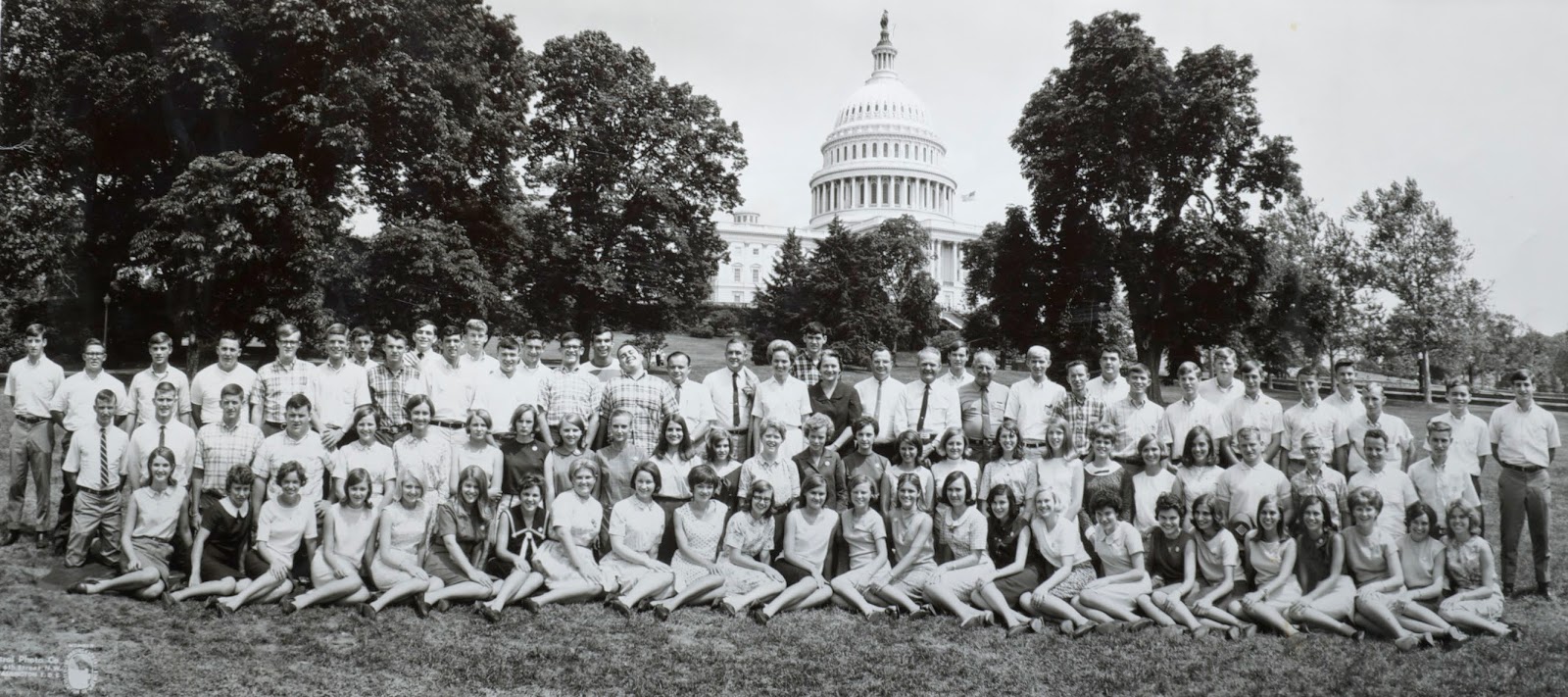
A half-century ago, many people considered high-tech to be electric typewriters and color TV.  And for many in the Class of 1966, a panoramic camera was high-tech, too.  As the Jesup High School graduates posed on the lawn of the U.S. Capitol, class president Jimmy Watson appeared on both ends of the group.  How did he do that?  When the photographer gave the sign, Jimmy ducked and raced behind his classmates to reach the other end before the sweeping lens got there.  Traveling as chaperones were Barry Weinstein, Ashley and Anita Madray, Kathleen Hires and Jim Collins. (Photo courtesy of Joe and Judy Bennett Phelps)  
     When you are 17, you believe you are going to live to be 100.  But on a 1965 summer morning, the Class of 1966 awoke, realizing that belief was a cruel myth.  Cary Bennett’s death in a car crash wasn’t just a bad dream.  It was a nightmare that shook us awake.
     I remember walking into the locker room and staring at the steel cage where Number 45’s jersey “Cary’s gone!”      
Dink NeSmith, circa 1966
was hanging.  Cary was supposed to be there, peeling off his street clothes and putting on his sweaty gridiron gear.  That’s when reality hit: 
     The popular rising-senior’s funeral was the first, but many have followed since Principal Charles E. Bacon and Superintendent James E. Bacon handed us our diplomas on May 31, 1966.
     Fast-forward almost a half-century.  Someone had an idea. Maybe it was Kenny Bryant or his wife, Patti Park Bryant.  Maybe it was Angela Walker Story, Beverly Westberry Leaphart, Tricia Bennett Neace or Ann Bailey Lane.  Many people—but not me—deserve credit.  Still, somebody did the math.  Most of the class members were born in 1948, and we’ve been out of Jesup High for 48 years.  Then consider the Class of  ’66 is turning 66.  So what does that mean? 
     It’s party time!
     After months of planning, the shindig is this weekend.  Angie, whose dad owned Walker Chevy-Olds back in our youth, is reopening the former dealership showroom for the celebration.  We danced on that terrazzo floor about 50 years ago, when she hosted a Christmas party.  
     As Yogi Berra said, “It’s déjà vu all over again.”
     The older I get, the more I poke around in my cobwebs, searching for memories that I don’t want to misplace.  Mark Twain joked, “When I was young, I could remember anything whether it happened or not.”  Thinking about 1966, I am convinced these things really did happen:

March 4, 2014

Nanelle Bacon helped me ‘to see’

     Go with me for a moment.  But first, close your eyes.  We’re taking a trip back to 1960.  We’ve just
Nanelle Surrency Bacon, circa 1960
1924-2014
turned onto East Plum Street, heading to the site of the old Jesup High School. We’re going to park our car underneath the pines on the left, and then climb the steps to the big brick building.  The first door on the left is James E. Bacon’s office.  He’s the principal of Jesup Junior High.
     Can you smell the floor sweep on those oil-soaked wood boards that squeak beneath our feet?  On the right is the auditorium with those dusty, hunter-green velvety curtains, but our destination is the second door on the left.  Can you hear the chalk striking the green blackboard?  It’s a sharp—but faint—sound, overpowered by the commanding voice of my teacher, the principal’s wife, Mrs. Nanelle Bacon.  I can see my seventh- and eighth- grade homeroom teacher, with her hair pulled back into a tight bun.
     “Class,” she booms, “today, I am going to give you eye exams.  When I call your name, sit in this chair in the front of the room.”  When I was called, Mrs. Bacon pointed to the chart.   I read what I thought I saw.  After several tries, she exclaims, “Good Lord, son, you are blind.  Tell your mama to get you to Dr.  Mel Wilson—this afternoon!” 
     As you open your eyes, I promise you that Nanelle Bacon opened my eyes—literally and figuratively.  When I put on glasses, I could see that writing on the blackboard wasn’t fuzzy, and leaves on trees had different shapes.   The before-and-after difference was startling.  But that’s not all.  Nanelle Bacon encouraged me to have vision for my life.  And for a half-century, she was one of my most ardent advocates.  She flooded her students with the power of positive thinking.
     On a cold winter night in 1961, Mrs. Bacon invited me to supper with her family at their Oglethorpe Community farm.  She served scrambled eggs, hog brains and biscuits.  I quizzed her, “Do you think these hog brains will help me with my math.”  She laughed and said, “Well, they certainly can’t hurt. Here, let me give you a second helping.”
     No matter where I saw her, she’d always ask—with a stern look: “Do you have your homework?”  And if ever she encountered our children, Alan, Emily and Eric, she delighted in telling them, “I thought your daddy was going to flunk seventh grade math because he couldn’t do decimals.  But then, I told him to put a dollar mark in front of them.  He never missed another problem.”
     Teachers have a huge influence on their students.  Oftentimes, more influence than parents.  Nanelle Bacon excelled in that all-important role.  If you could only have one such teacher, you’d want him or her to be as passionate, as caring as Nanelle Bacon.

December 25, 2013

‘It is more blessed to give than to receive’

“In everything I did, I showed you that by this kind of hard work we must help the weak, remembering the words  the Lord Jesus himself said: ‘It is more blessed to give than to receive.’”
Acts 20:35 NIV


     Regardless of your faith, the Apostle Paul’s admonishment should be a caution to every one of us.  Tearing into Christmas packages is exciting, especially when the spirit of Santa lives under your roof. You listen to squeals brought about by Barbie dolls, bicycles, iPods, video games and all the gifts that put smiles on faces. 
      But we shouldn’t stop there.  When’s the last time you put a smile on a stranger’s face?  How about your children?  Have they discovered the blessing of giving to people they don’t know?
     When the presents are exchanged at your house, try this.  Load up your family and take them to the nearest nursing home or retirement center.  Ask for permission to visit with the residents.  You don’t have to buy anything.  Just a stack of child-made cards will work magic.  Lonely faces will light up like the brightest Christmas tree.